
Search St. Paul Traffic Ticket Records
If you received a traffic citation in St. Paul, the record is filed with the Ramsey County District Court, not with the city. St. Paul is the state capital and the seat of Ramsey County, with more than 310,000 residents. Traffic tickets issued by the St. Paul Police Department or by state troopers within city limits all flow through the district court. This page covers how to find your case, pay your fine, contest the ticket, and understand what a conviction means for your license.
St. Paul Traffic Overview
Where St. Paul Traffic Citations Are Filed
Traffic violations in St. Paul are handled by the Ramsey County District Court, which is part of Minnesota's 2nd Judicial District. The court sits at 15 W Kellogg Blvd in downtown St. Paul. When the St. Paul Police Department issues a citation, the ticket is submitted to the court, which creates a case record and sets any applicable deadlines.
St. Paul Parking Services at (651) 266-9777 handles parking violations only. Their website at stpaul.gov/departments/parking-services covers parking permit disputes and meter citations. If you got a moving violation, such as speeding or failure to yield, that goes to the Ramsey County District Court, not to parking services. The two offices deal with completely different types of citations.
The Ramsey County courthouse is accessible by public transit and has a parking structure nearby. You need to go through security to enter. The Court Administrator handles all traffic records and payments. Ramsey County also operates a Hearing Officer program for eligible citations, giving drivers another option beyond going in front of a judge.
| County Court | Ramsey County District Court |
|---|---|
| Address | 15 W Kellogg Blvd, St. Paul, MN 55102 |
| Phone | (651) 266-8269 |
| Hours | Monday through Friday, 8:00 AM to 4:30 PM |
| County Page | Ramsey County Traffic Ticket Records |
Looking Up St. Paul Traffic Ticket Records
The Minnesota Court Records Online system (MCRO) lets you search traffic case records for free. It covers the Ramsey County District Court and pulls up case information by name or case number. New cases take about seven days to appear in the public search tool after a citation is issued. If you just got a ticket, give it a week before checking.
Access the case search at publicaccess.courts.state.mn.us. You will need your full name as it appears on the citation, or your case number if the ticket has one printed on it. The search results show party names, case type, filing date, and current case status. Some fields may be restricted for certain case types, but basic traffic citation records are generally public.
The St. Paul Police Department at stpaul.gov/departments/police handles enforcement of state traffic laws within city limits. SPPD enforces Minnesota's hands-free driving law under Minn. Stat. § 169.475, speed limits, traffic signals, and other provisions under Chapter 169 of the Minnesota Statutes. Knowing which law applies to your citation can help if you decide to contest it.
The screenshot below shows the MCRO public access case search portal. This is where St. Paul traffic ticket records appear after filing with the Ramsey County District Court.
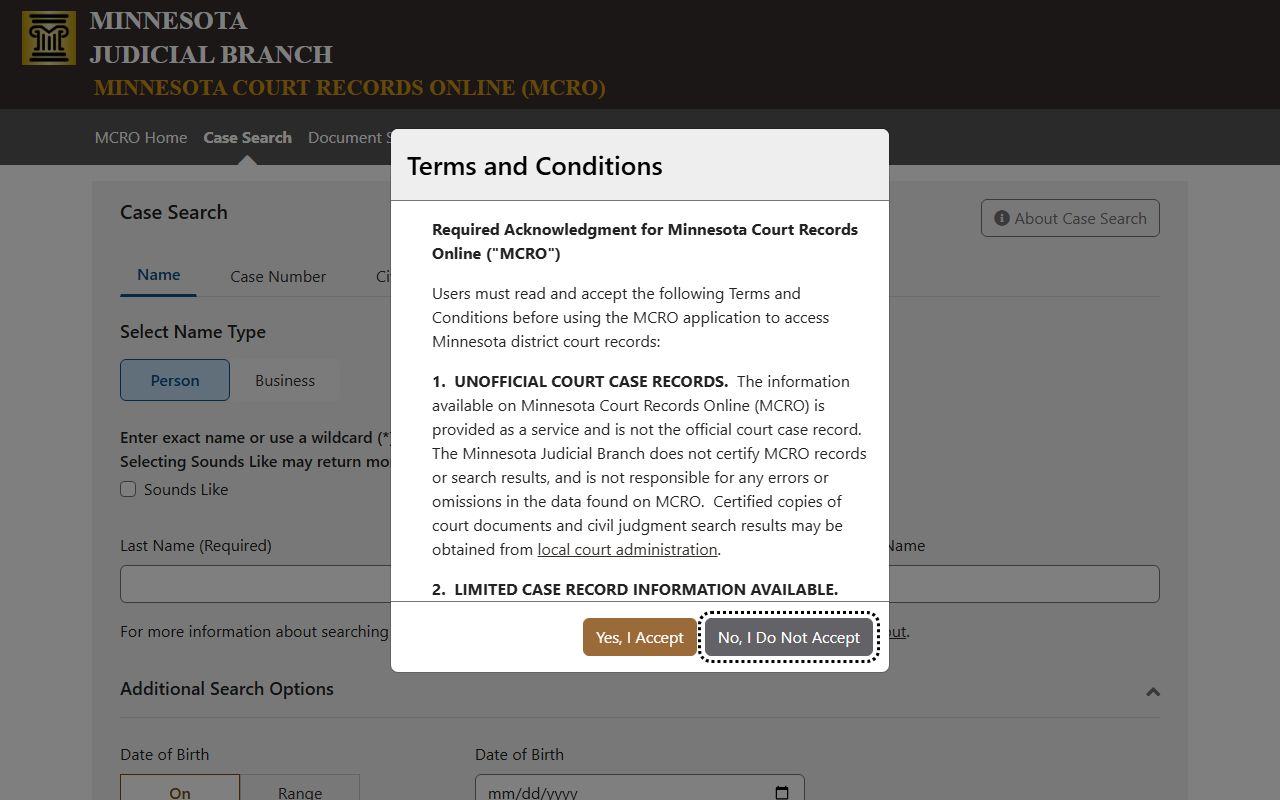
MCRO is free to use and requires no login. Search results include hearing dates, docket entries, and the current disposition of your case.
The St. Paul Police Department website is shown below, where you can find information about traffic enforcement units and city-specific programs.
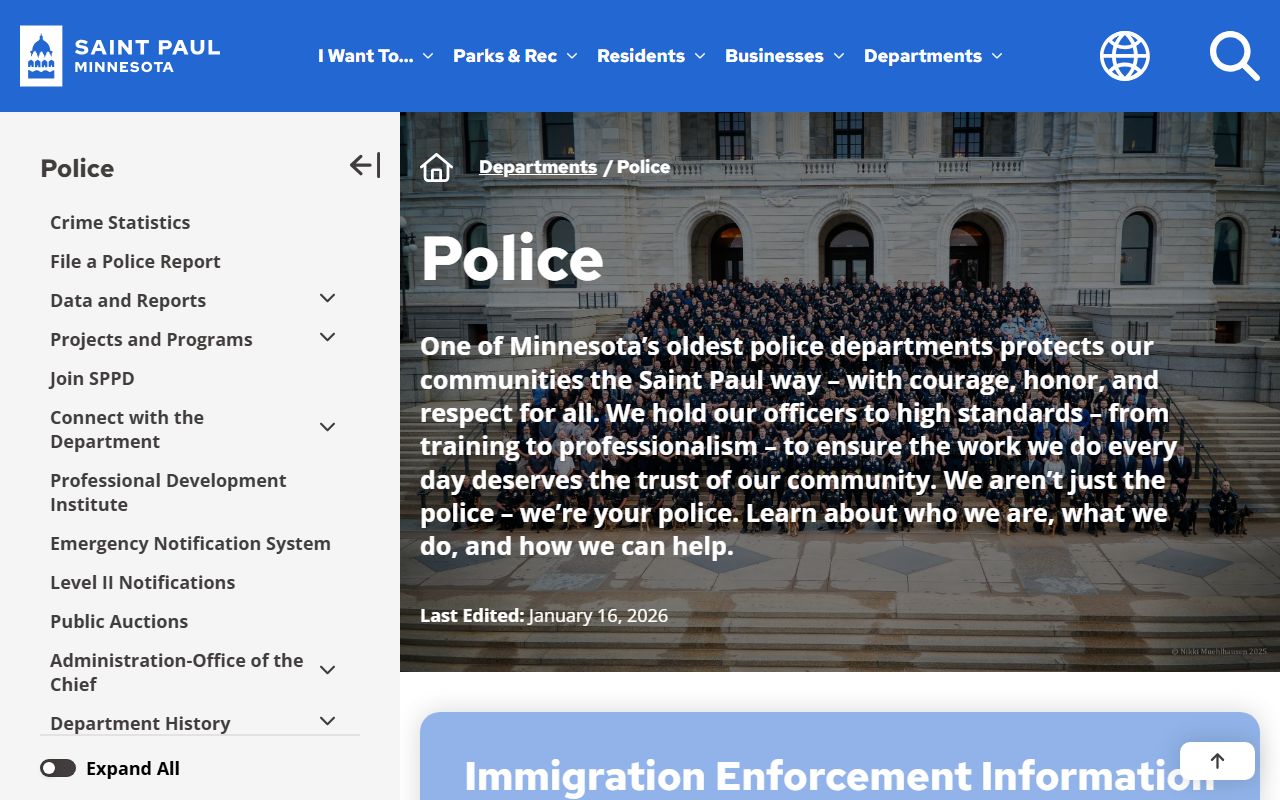
SPPD issues citations for both state and local traffic violations. All moving violation records are maintained by the Ramsey County District Court.
Paying a Traffic Ticket Issued in St. Paul
St. Paul traffic fines are paid to the Ramsey County District Court through the Minnesota courts' payment system. You have a few ways to do it. Online is the fastest option. Phone and mail work too. In-person payments can be made at the courthouse during business hours.
To pay online, go to webpay.courts.state.mn.us. You'll need your case number or citation number. A $2.34 processing fee is charged for card payments. The site accepts major credit and debit cards. Make sure you get a confirmation number or receipt after paying. That proves the payment went through.
Phone payments can be made by calling (651) 281-3219 or toll-free at (800) 657-3611. The same $2.34 fee applies. For mail payments, write a check or money order payable to District Court Administration and send it to P.O. Box 898, Willmar, MN 56201. Put your case number in the memo line. Do not mail cash.
In-person payments are accepted at 15 W Kellogg Blvd during court hours, Monday through Friday from 8:00 AM to 4:30 PM. Bring your citation paperwork and a form of payment. Cash, check, and credit cards are generally accepted at the counter. The clerk can tell you the total amount owed, including any added court fees.
You must respond within 30 days of the date the citation was issued. If you pay, the case is closed and a conviction is recorded on your driving record. If you want to fight the ticket, do not pay. Contact the court to request a hearing before the 30-day window closes.
Contesting a St. Paul Traffic Citation
You have the right to contest any traffic citation issued in St. Paul. You must act within 30 days. To contest a citation, contact the Ramsey County District Court and tell them you want a hearing. Do not pay the fine. Paying closes the case and results in a conviction, even if you think the ticket was wrong.
Ramsey County has a Hearing Officer program for certain eligible citations. A hearing officer reviews the citation outside of a traditional courtroom setting. This process is typically quicker than waiting for a judge, and some citations get reduced or dismissed at this stage. Ask the court when you call whether your citation type qualifies for the hearing officer track.
If you request a court hearing before a judge, you will get a date to appear. You can bring evidence, such as photographs, witness statements, or dashcam footage. The issuing officer is expected to appear as well. If the officer fails to show, the case may be dismissed. You can represent yourself or hire an attorney.
For serious charges like careless driving or driving after revocation, having an attorney is worth considering. An attorney experienced in Minnesota traffic law can assess your chances and advise on whether to fight or negotiate with the prosecutor. Many attorneys offer free initial consultations for traffic cases.
Note: Courts in Minnesota do not use a point system for traffic violations. Convictions still affect your driving record and may raise insurance rates.
What Happens If You Don't Pay
Failing to respond to a St. Paul traffic citation leads to a default conviction. The court enters the conviction automatically if you do nothing. The fine stays on your account, and the Minnesota Department of Public Safety is notified. Your driver's license may be suspended as a result.
A suspended license means you can't legally drive. If you're stopped while suspended, you face additional criminal charges on top of the original violation. Getting your license reinstated requires paying the original fine, paying DVS reinstatement fees, and potentially dealing with other conditions depending on the reason for suspension.
If your fine goes to the state collections unit, call (800) 657-3909. Late-stage collection adds fees to your balance. The sooner you deal with an unpaid ticket, the less it costs overall. Waiting makes it worse, not better.
If you believe a default was entered by mistake, such as because you never received the citation, you can ask the court to reopen the case. Contact the Ramsey County District Court at (651) 266-8269 to explain your situation. The court will evaluate your request, but there is no guarantee they will reopen it.
Driving Record Consequences in Minnesota
A traffic conviction from a St. Paul citation appears on your Minnesota driving record. The state tracks convictions even though it has no point system. Insurance companies pull driving records and use them to set your rates. A clean record means lower premiums. Frequent violations push rates up, and some insurers may drop coverage entirely.
You can request your driving record through DVS at drive.mn.gov. The online service gives you your full record, including all convictions and license actions going back several years. There is a fee for official copies. If you're shopping for auto insurance or applying for a driving job, it's worth checking your record first so you know what's on it.
Minnesota traffic law is primarily governed by Minn. Stat. Chapter 169. Key sections include § 169.89, which covers fines and penalties, and § 169.99, which establishes the uniform traffic ticket form. Driving record reporting is governed by § 171.12, which requires DVS to record all convictions from courts across the state.
Serious violations carry heavier consequences. DWI convictions under Minn. Stat. § 169A involve license revocation, required chemical assessments, and possible ignition interlock. Reckless driving is a misdemeanor. Even lesser violations, if repeated, can lead to a driver improvement interview or other administrative action by DVS.
Nearby Cities
St. Paul neighbors several qualifying cities in the east metro. Traffic in each is handled through the district court for that city's county.