
Minnesota Traffic Ticket Records
Minnesota traffic ticket records are filed with the District Court in the county where each violation occurred. All 87 counties use the same statewide systems for payments and case access. You can look up traffic ticket records online through Minnesota Court Records Online, pay fines through the Court Web Payment portal, or contact the local courthouse directly. This guide covers how to find traffic ticket records in Minnesota, your options for paying or contesting a citation, what happens to your driving record after a traffic conviction, and where to turn if you need help.
Minnesota Traffic Ticket Records Overview
How to Pay a Minnesota Traffic Ticket
All traffic fine payments in Minnesota run through the Minnesota Court Payment Center, which handles citations from all 87 counties. You do not need to drive to a courthouse to pay most petty misdemeanor tickets. Four payment options cover almost every situation, and the state makes it easy to take care of the whole thing online or by phone.
The Minnesota Judicial Branch's pay-a-fine page at mncourts.gov/pay-a-fine is the best place to start. It outlines all payment methods, explains what to do if a citation is not yet in the system, and links to Spanish language resources for non-English speakers. That page also covers proof of insurance submissions for drivers who had coverage on the day of the stop but did not have their card with them.
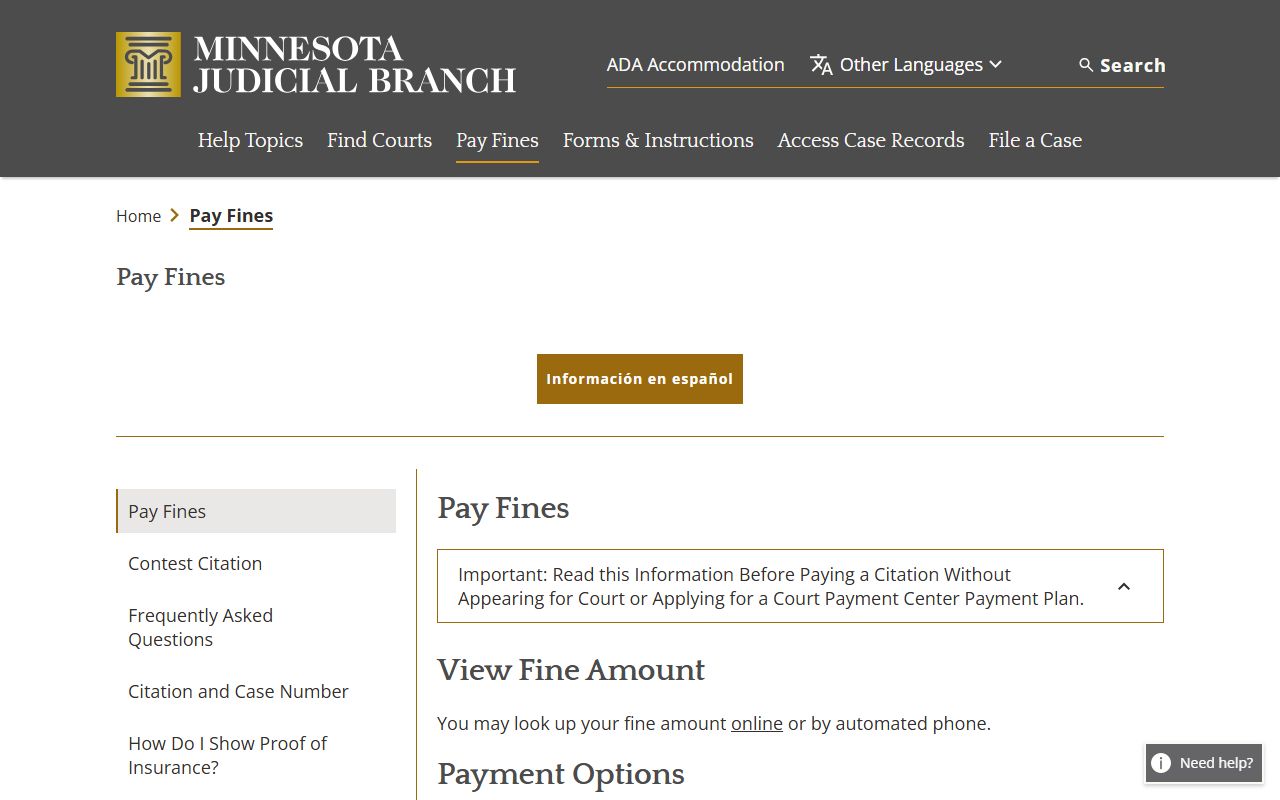
The fine payment page also explains the seven-day window you must wait after your citation date before the system can find your case.
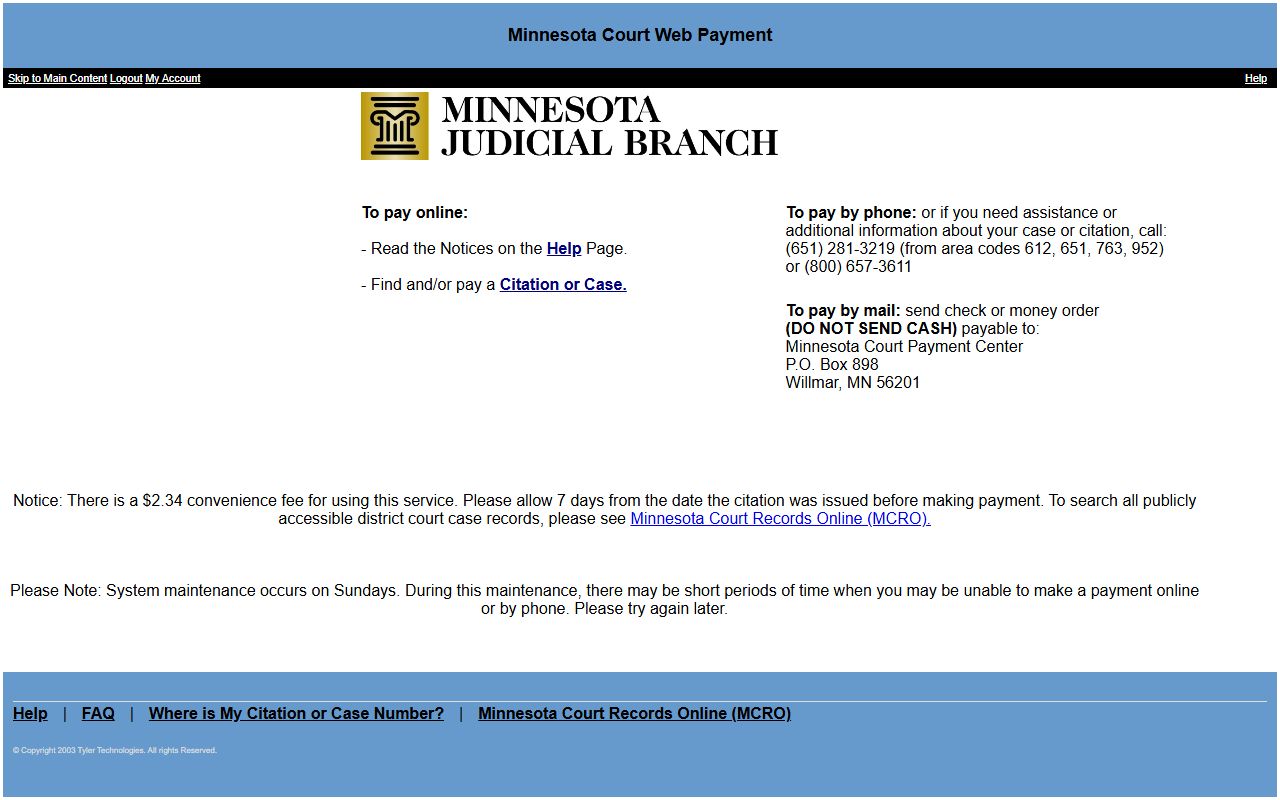
Online payment is the quickest route. The Court Web Payment system accepts Visa and MasterCard credit and debit cards, plus electronic bank transfers from checking or savings accounts. A $2.34 convenience fee applies to every online transaction. The system runs around the clock except during Sunday maintenance from 9:00 AM to 4:00 PM. One thing to know: if the system returns a "No Records Found" message, your citation probably has not been entered yet. Try again in two or three days.
After a successful payment, the system displays a confirmation number. Write it down or print the screen. Payments typically post to the case within 24 hours, though the system may take up to 48 hours to reflect the change.
Phone payments use the same automated system. Metro area callers in the 612, 651, 763, and 952 area codes dial (651) 281-3219. Everyone else uses the toll-free number at (800) 657-3611. Both lines accept Visa and MasterCard. The $2.34 convenience fee applies here too.
To pay by mail, write a check or money order payable to "District Court Administration." Never mail cash. Send to: Minnesota Court Payment Center, P.O. Box 898, Willmar, MN 56201. Put your citation number in the memo line. Allow 7 to 10 business days for processing. Mail payments carry no convenience fee.
In-person payment is accepted at any Minnesota District Court, Monday through Friday, 8:00 AM to 4:30 PM. Courts accept cash, checks, money orders, and credit or debit cards. Some locations have a secure drop box for after-hours drop-off. Do not leave cash in a drop box. Use checks or money orders only, and include your citation number.
Note: If your citation appears as "not payable" when you search online, the case may require a court appearance or has a hold on it. Call the Court Payment Center at (651) 281-3219 for guidance on next steps.
Search Minnesota Traffic Ticket Records Online
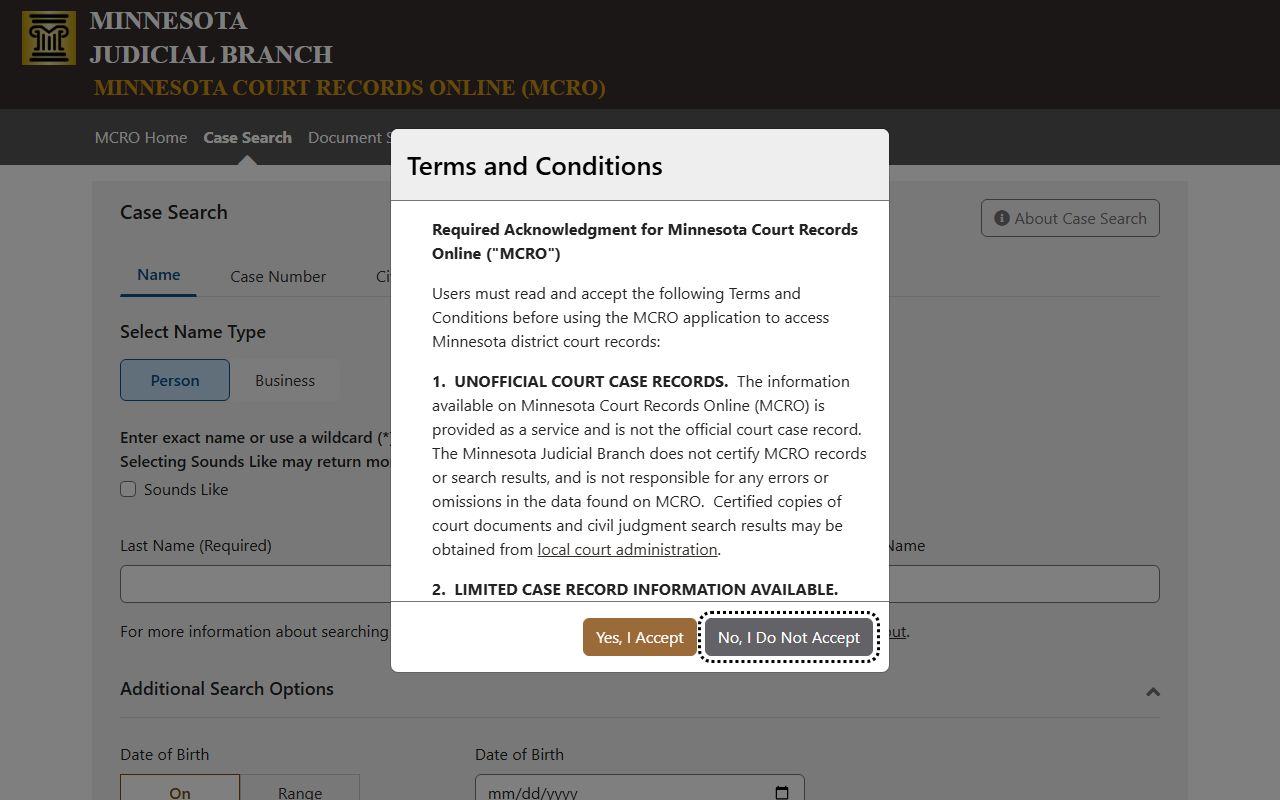
Minnesota Court Records Online, known as MCRO, is the state's free public access system for court case information. It launched in March 2021 and covers District Courts in all 87 Minnesota counties. You can search traffic ticket records by driver name, citation number, or court file number. Basic case searches are free. Some document downloads carry a small fee.
The MCRO case search portal offers four search types: Case Search, Document Search, Hearing Search, and Judgment Search. For traffic ticket records, the Case Search is what you need most of the time. Search by the driver's name or the citation number printed on the ticket. Results show the case number, party names, charges, current case status, and a Register of Actions that lists every event in chronological order. Wildcard searches help when you are not sure of the exact spelling. Type the first two or more letters followed by an asterisk, like "Smi*," and the system finds Smith, Smiley, and Smithson. You cannot use wildcards with the Sounds Like option.
The search results show hearing dates, outstanding balances, and payment history, so you can confirm what has been paid before making any additional payments.
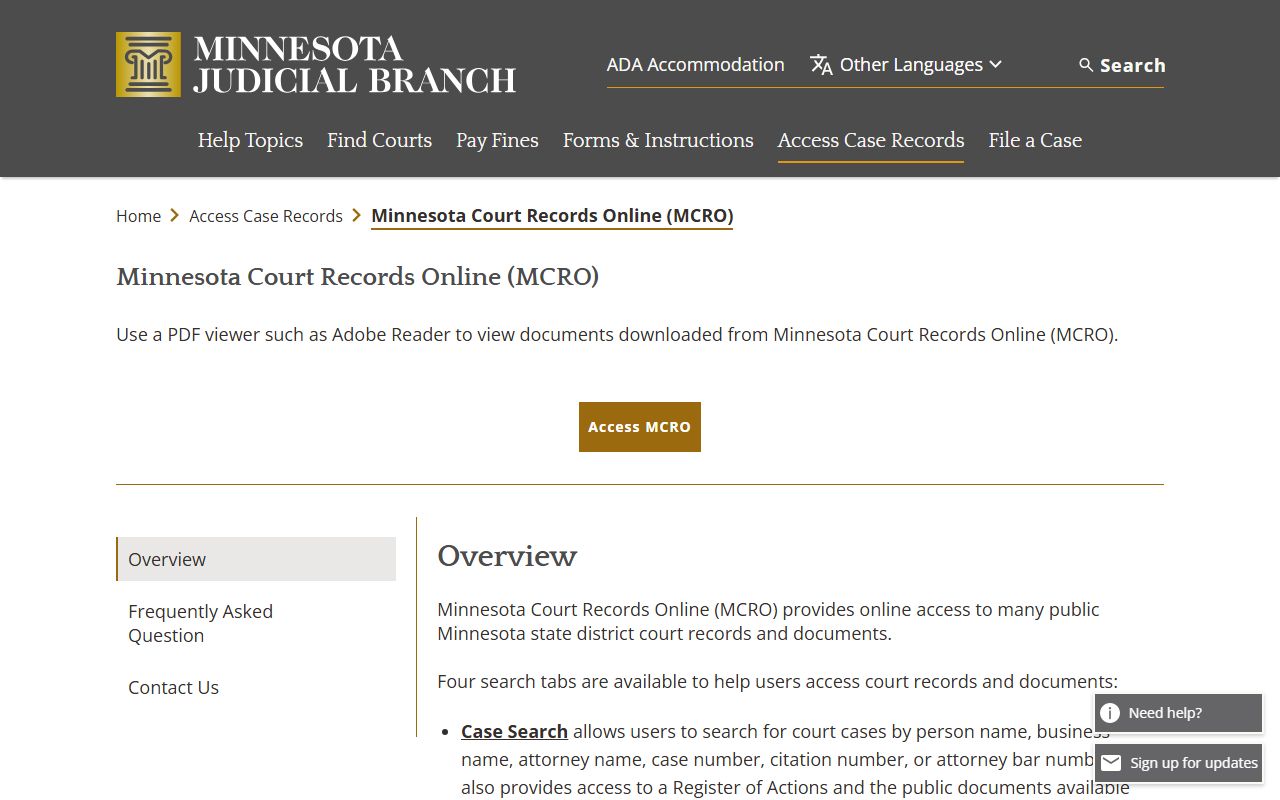
The MCRO information page at mncourts.gov/access-case-records/mcro has quick reference guides and handouts explaining how to read case details and search results. Over two million court documents have been downloaded from the system since it launched. For cases filed before July 1, 2015, documents may have limited availability. Contact the court administrator in the county where the case was filed for older records.
Self-Help Centers at courthouses across the state offer in-person help with MCRO searches. Staff there can walk you through the process at no charge.
Contesting a Minnesota Traffic Citation
You have the right to contest a traffic citation in Minnesota rather than paying the fine. Paying the fine counts as a guilty plea and puts the conviction on your driving record. If you want to fight the ticket, you need to act within 30 days of the citation being filed with the court. Missing that window results in an automatic guilty plea by default for petty misdemeanor cases.
Minnesota offers a Hearing Officer program in seven counties: Anoka, Carver, Dakota, Hennepin, Ramsey, Scott, and Washington. These counties handle a large share of the state's traffic volume. Call the Court Payment Center at (651) 281-3219 or (800) 657-3611 to schedule a Hearing Officer appointment. Hearing Officers are not judges, but they can hear your case and offer several outcomes. Those options include a reduced fine, a payment plan, a continuance for possible dismissal with prosecution costs, or a guilty plea with a chance to explain the circumstances. The Hearing Officer process tends to be faster and less formal than a full court hearing.
In the other 80 counties, contesting a ticket means contacting the local court administration office where the citation was filed. Procedures vary somewhat by county, but the general path involves requesting a court date and appearing before a judge. For misdemeanor traffic charges, you have the right to a jury trial and may hire an attorney at your own expense. A public defender may be available if you qualify based on income.
If you paid a fine but later realized you did not understand what it meant, you can file a Motion to Withdraw Guilty Plea and Vacate Conviction using Form CRM1002. That form is available at mncourts.gov. File it with the court where the case was originally filed. A judge will decide whether to grant the motion at a hearing.
Minnesota Traffic Laws and Violation Classes
Most traffic violations in Minnesota fall under Minnesota Statutes Chapter 169, the state's primary traffic code. It covers speed limits, equipment requirements, school bus laws, distracted driving, and hundreds of other rules for operating a vehicle on public roads. Citations issued under Chapter 169 make up the vast majority of Minnesota traffic ticket records.
Under Minn. Stat. § 169.89, traffic violations fall into three main classes. A petty misdemeanor is a fine-only offense. It is not a crime in the formal legal sense, but it goes on your driving record and can raise insurance rates. Most speeding tickets, seat belt violations under Minn. Stat. § 169.685, and equipment citations are petty misdemeanors. The base fine is usually $100 to $300, but mandatory surcharges often double or triple the total bill. A $100 base fine can become $200 to $300 after surcharges that fund the State Patrol, law library, court technology, and victim services programs. A misdemeanor traffic offense carries up to 90 days in jail and a $1,000 fine. Reckless driving, driving after suspension, and certain no-insurance violations fall here. Gross misdemeanors are more serious, carrying up to one year in jail and a $3,000 fine. Passing a stopped school bus with its stop arm extended is a gross misdemeanor under Minn. Stat. § 169.444 and carries a minimum $1,000 fine on top of criminal record consequences.
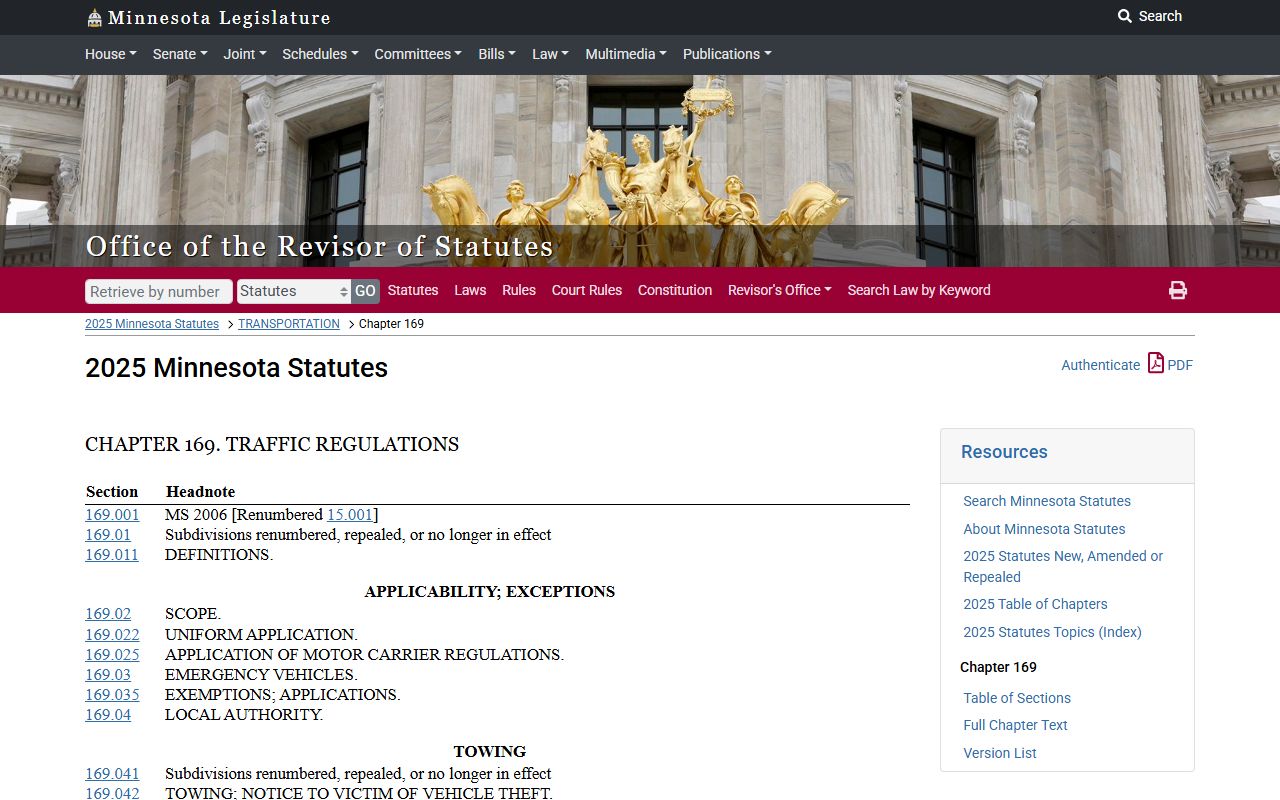
Chapter 169 also governs Minnesota's Hands-Free law at Minn. Stat. § 169.475. Holding a phone while driving is prohibited. First violations carry a $50 base fine. Second and subsequent violations cost $275 before surcharges.
Under Minn. Stat. § 169.99, Minnesota uses a standardized Uniform Traffic Ticket statewide. Every officer who issues a citation must use this form. It contains the statute number, violation description, vehicle information, and court details. When the officer files it with the court, it becomes the official charging document. Many agencies now use electronic citation devices that send ticket data directly to the court system, which speeds up the time it takes for your citation to appear in the payment portal.
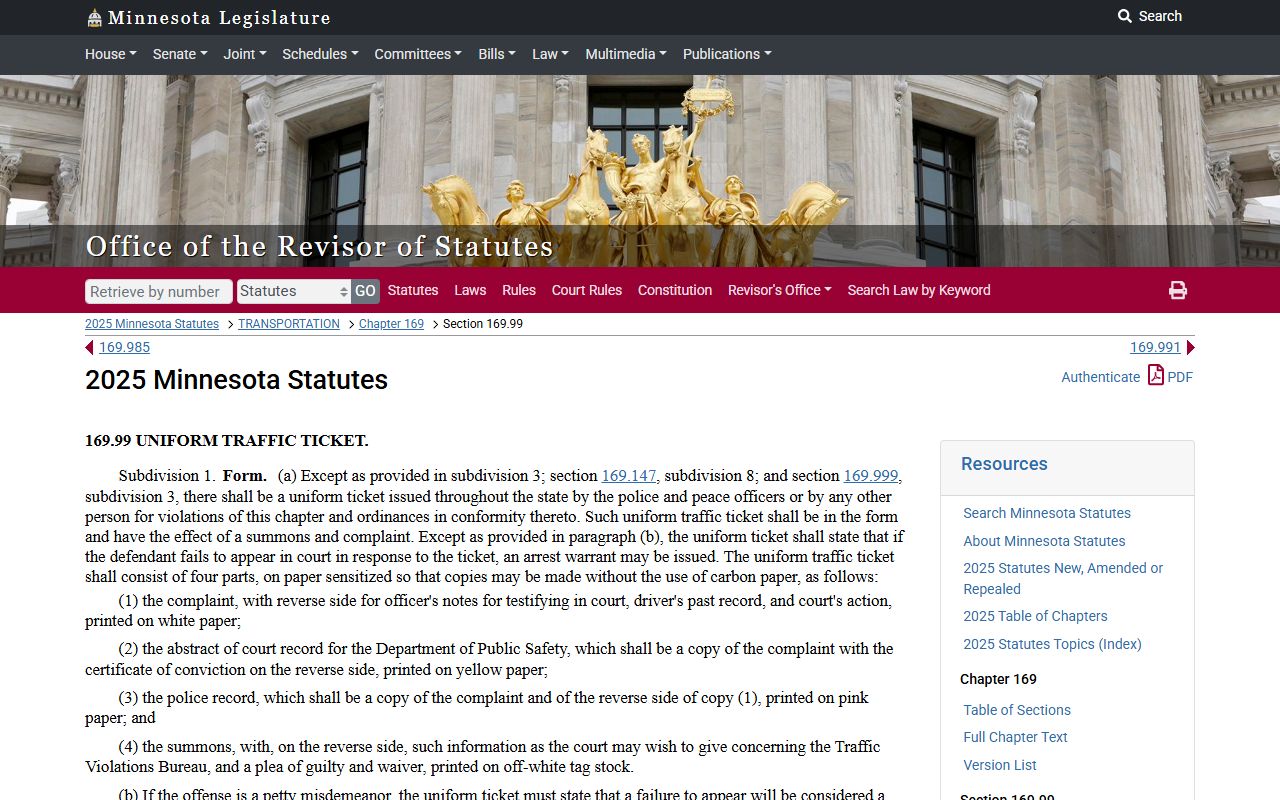
The statute also authorizes electronic signatures and digital transmission, so paper tickets and e-citations carry equal legal weight.
Driver's License Consequences and DVS Records
The Minnesota Department of Public Safety, Driver and Vehicle Services division, maintains driving records for every licensed driver in the state. DVS operates through more than 243 local offices and deputy registrar agencies across all 87 counties. Online services are available at drive.mn.gov, where you can check license status, renew online, update your address, and request a copy of your driving record.
Minnesota does not use a point system for traffic violations. Instead, DVS records every conviction chronologically. The number and severity of convictions within a given time period determines whether any license action occurs. Three petty misdemeanor convictions within 12 months becomes a misdemeanor charge on its own. Three misdemeanor convictions within 12 months, or five within 24 months, can trigger license revocation. Exceeding 100 miles per hour results in an automatic six-month revocation regardless of your prior record. These are separate from DWI administrative penalties under Minn. Stat. § 169A.20, which has its own lookback period and penalty structure.
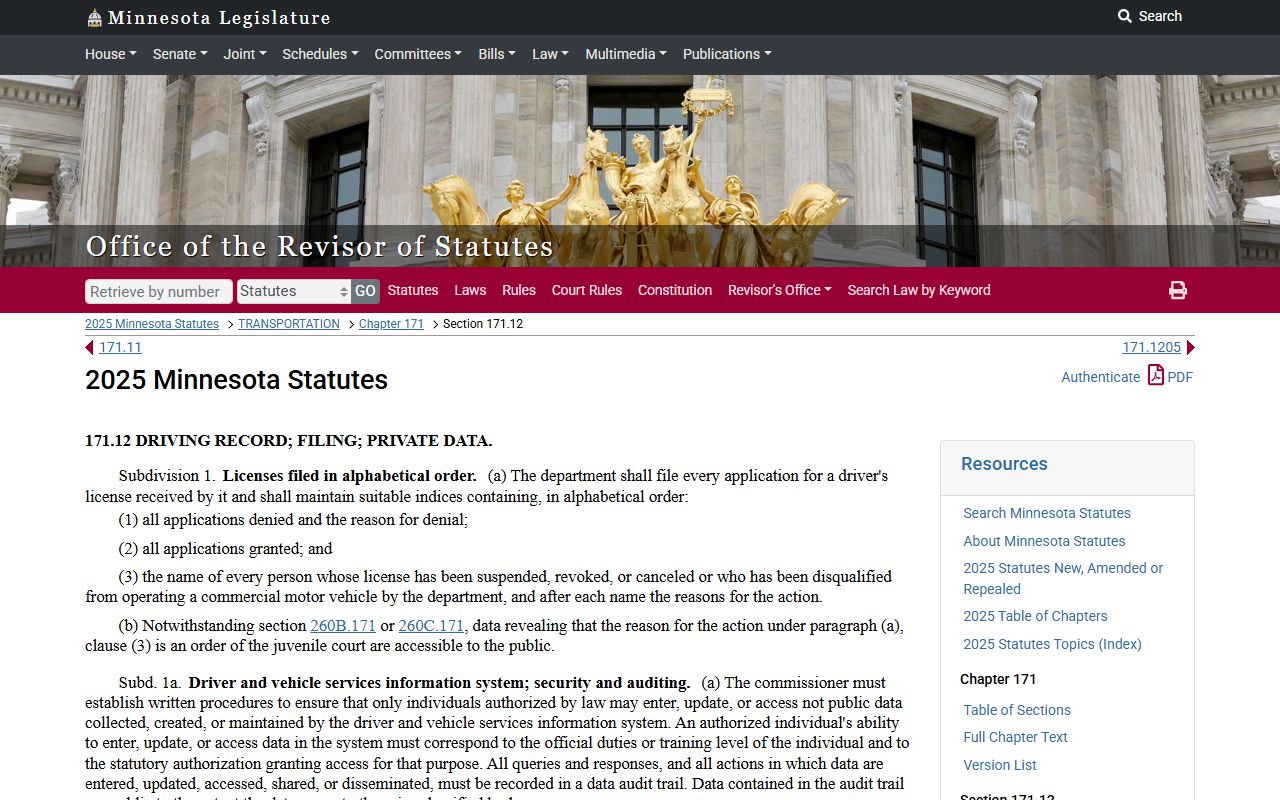
DVS receives conviction reports from courts within 10 days under Minn. Stat. § 171.12. Minor traffic violations may purge from your record after five years. DWI convictions remain for at least 10 years.
To reinstate a suspended license, you serve the full suspension period, pay a reinstatement fee of about $30 for most suspensions, pass any required tests, complete any court-ordered programs, and provide proof of insurance if required. Reinstatement is not automatic. You must apply and meet all conditions. For questions about your specific situation, contact DVS at (651) 284-1000 or visit dps.mn.gov/divisions/dvs/.
What Happens When You Don't Pay a Traffic Ticket
Ignoring a traffic ticket in Minnesota leads to a chain of consequences. For petty misdemeanor citations, missing the 30-day response deadline results in an automatic guilty plea. The court enters the conviction, reports it to DVS, and your license may be suspended until the fine is paid and any reinstatement requirements are met.
Unpaid fines eventually get certified to the Department of Revenue Collections. That office can be reached at (800) 657-3909, Monday through Friday, 8:00 AM to 4:30 PM. Collections adds a fee of 20 to 30 percent to the outstanding balance. From there, collectors can levy bank accounts, garnish up to 25 percent of wages, intercept state tax refunds, and place liens on property. A collections record can stay on your credit report for seven years. Paying collections does not automatically clear your license suspension. You still need to complete the DVS reinstatement process separately after settling the debt.
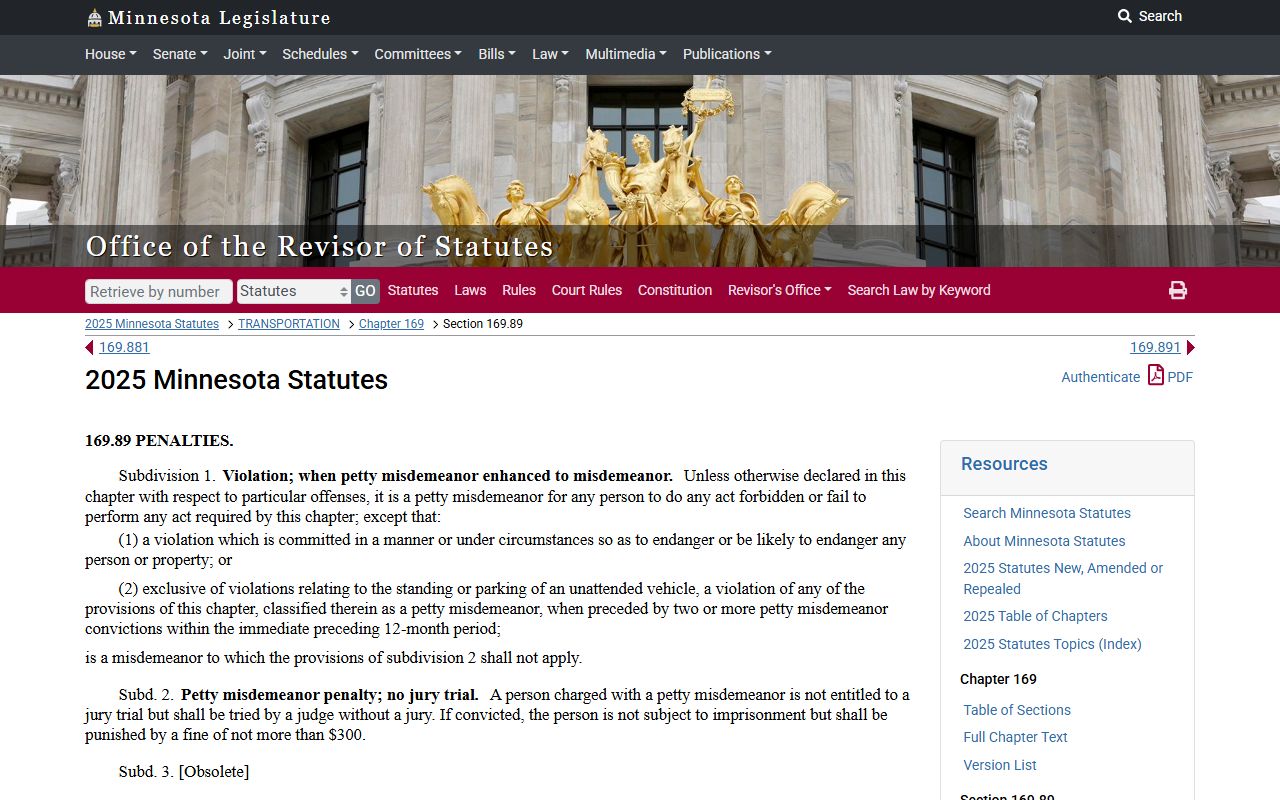
The penalty structure under Minn. Stat. § 169.89 sets the maximum base fine for each violation class. The total on your bill reflects those maximums plus mandatory surcharges.
Under Minn. Stat. § 171.12, DVS keeps a complete history of all license actions. Unpaid fines tied to a suspension show as active suspensions until the fine is paid and the reinstatement process is complete. Minor violations may be purged after five years. DWI and serious violations may stay permanently.
Getting your driving privileges back requires paying the full balance, completing reinstatement through DVS, and meeting any other conditions set by the court.
Payment plans are available for people who cannot pay the full amount at once. Call the Court Payment Center at (651) 281-3219 or (800) 657-3611 to ask about eligibility. In the seven Hearing Officer counties, a Hearing Officer can set up a payment plan during your appointment.
Legal Help and Self-Help Resources in Minnesota
Self-Help Centers run by the Minnesota Judicial Branch offer free procedural assistance to people without lawyers. Staff can explain how the court process works for traffic ticket records, help you find forms, and point you to legal aid organizations. They cannot give legal advice or represent you in court. Centers operate in Hennepin, Ramsey, Dakota, St. Louis, Stearns, Blue Earth, and other counties. Visit mncourts.gov for a full directory of locations and hours.
The State Law Library in St. Paul at Room G25, Minnesota Judicial Center, 25 Rev. Dr. Martin Luther King Jr. Blvd., St. Paul, MN 55155 provides free legal research help. The website at mn.gov/law-library has access to statutes, court rules, and practice guides. Librarians can help you find information on traffic violation laws, license reinstatement procedures, and how to challenge a conviction.
For proof of insurance submissions on a "no proof of insurance" citation where coverage was actually in place on the date of the stop, submit proof within 30 days of the citation date. Acceptable documents include a copy of your insurance card, a letter from your agent on company letterhead, or a copy of the policy declarations page. Mail submissions to Minnesota Court Payment Center, P.O. Box 898, Willmar, MN 56201. You can also fax to (320) 231-6507. Include a copy of the citation with your proof.
Browse Minnesota Traffic Ticket Records by County
Each of Minnesota's 87 counties has its own District Court that handles traffic citations filed in that county. Pick a county below to find local court contact info, payment options, and resources for traffic ticket records in that area.
View All 87 Minnesota Counties
Traffic Ticket Records in Major Minnesota Cities
Traffic citations issued inside city limits are handled by the District Court in that city's county. Pick a city below to find traffic ticket record information specific to that area.